

dScope Series III analogue and digital audio analyzers
System Overview:
The dScope Series III is a comprehensive and powerful measurement system for analogue and digital audio generation and analysis, including digital audio carrier parameters, acoustic transducers and Windows™ sound devices (WDM or ASIO).
Spectral Measurement dScope M1: analogue and digital audio test system
For information about the new dScope M1 family of interfaces please visit dScope Series III M1 page. For a general description of the dScope system and software capability please read on.
dScope Series III audio analyzer is an industrial strength audio test and measurement system comprising a Windows PC software application coupled with an external high-precision audio interface processor for equipment-under-test (EUT) connections.
The dScope Series III architecture makes the most of the ever-increasing processing and multi-tasking capabilities of the Windows platform to allow the system to measure many parameters simultaneously - and that means faster. The external interface processor connects to the PC via a standard USB connection making it easy to use with a wide range of PCs, including laptops.
The external interface processor includes precision analogue and digital outputs and inputs that are highly optimised for measurement applications. Precise and automatic gain ranging allows high resolution measurements over a phenomenal range from a few micro-volts to more than 150 volts RMS, and from less than 1 Hz to over 90kHz. The dScope Series III interface processor uses dedicated DSP to provide a wide range of real time measurements, and the dScope Series III software uses the host PC for almost unlimited number crunching and analysis options such as Fast Fourier Transforms (FFT FFT: Fast Fourier Transform
(click for a glossary definition)), power spectrum analysis, swept sine and multi-tone testing. The dScope interface processor also provides controlled degradation and analysis of AES3 Look up 'AES3' in the glossary. and S/PDIF S/PDIF: Sony/Philips Digital Interface
(click for a glossary definition) digital audio carriers. The software also allows the dScope to use installed Windows sound devices such as sound cards or bluetooth audio headsets as generator outputs or analyzer sources using either WDM or ASIO drivers. This also enables dScope to either use external devices as additional inputs or outputs, or to test those inputs or outputs themselves.
dScope Series III is highly programmable - great for production test automation and for specialised custom audio analysis. It can also be automated from a wide range of third party software using ActiveX Look up 'ActiveX' in the glossary. controls - almost anything you can do with dScope can be automated and controlled remotely. In addition, the rich feature set of dScope Series III means that it can do the job of many traditional instruments which in turn means cost savings, especially when it is time for re-calibration!
There is also a growing list of auxiliary equipment such as an I/O switcher, a versatile serial digital audio interface adapter and a production test automation system called AutoTestSQL that further extend the capabilities of the dScope system.
dScope Hardware and System options
For information about the new dScope M1 family of hardware interfaces for dScope software please visit dScope Series III M1 page. This includes a table of features and options available for the dScope M1 interface family. There are a different set of options for dScope systems based on the dScope Series III System Unit. Please visit dScope Series III System features and options for details.The dScope Series III software from V1.50 can be used with both dScope Series III system units and with M1 family interfaces, but we still recommend V1.45 for the dScope Series III system units due to pending updates on the many support scripts, setups and documents.
The description of the dScope Series III software on this page and those linked to it is broadly applicable for both dScope Series III and dScope M1 ranges of hardware interfaces, though there are detail differences in capabilities depending on the particular unit selected.
Architecture: the best of both worlds
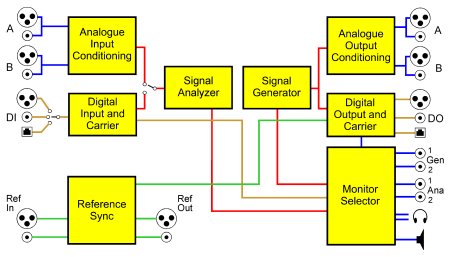 dScope Series III is primarily a software application with a dedicated hardware interface, but its architecture has been designed to give us the best of both worlds. Software gives us the flexibility, inter-operability and multi-tasking, hardware gives us control over the interfaces, gain ranging, and accurate calibration. Hardware only solutions lack the flexibility, tend to give only one result at a time, and can be very limited when it comes to integration with a manufacturing system. Software only solutions rely on sound cards and third party drivers to interface with the physical world and can suffer from obsolescence problems, lack of calibration and gain ranging issues. By using a carefully designed architecture, dScope Series III overcomes these problems.
The diagram to the right shows an overview of the dScope architecture with the analogue and digital inputs shown to the left and the generator analogue and digital outputs shown to the right. Click on the yellow blocks of the diagram to be taken to the related page in the architecture guide.
Internally, the dScope Series III is entirely digital. Waveforms for the generator are created digitally and fed to the analogue outputs through precision D/A converters with calibrated gain ranging. Similarly, the analogue inputs are gain ranged and fed to precision A/D converters.
Once the signal is digital, real time measurements are made in DSP DSP: Digital Signal Processor
(click for a glossary definition) in the dScope hardware. These are shown in the "Signal Analyzer" (RMS RMS: Root Mean Square
(click for a glossary definition) amplitude, frequency and phase measurements) and the "Continuous-Time Detector". The latter is effectively a voltmeter plus filter set with different response, filter and weighting settings that works with the time domain audio data.
The audio is also sent up the USB connection to the host PC for further analysis. This is also used to display a 'scope trace and frequency spectrum (FFT analysis) for both channels simultaneously. Measurements made on the PC in this way are shown in "FFT detectors". These are user programmable software instruments which can derive measurements from either the time domain data or the FFT transformed frequency domain data. With the power of modern PCs, up to 40 of these measurements can be made simultaneously. Almost any parameter that can be mathematically derived from the audio data can be measured in this way.
In addition the dScope Series III can hook in to the host PC Windows sound card architecture to enable it to generate and analyze signals through Windows sound devices (WDM or ASIO). This allows seamless measurements of signals from Windows sound devices and a full range of generation options. This is only possible with the dScope hardware connected.
All the usual audio measurements, but that's just the start
At its heart, the dScope Series III is an audio signal generator and audio signal analyzer in one system. All the standard audio measurements are there: amplitude, frequency, inter-channel phase, distortion etc., in a wide range of units with flexible relativity options, but that's just the start. The dScope Series III software has been designed to make it easy to perform accurate standard audio measurements quickly and easily, and then you can take it where you want with flexible "SmartFFT" analysis and programmable "soft" instruments.Within seconds of installing the software you can be taking measurements and getting results. The software can make a large number of measurements simultaneously and multiple screen "pages" allow you to manage and view these easily. Among the measurements that can be performed and displayed simultaneously are:
• Amplitude
• Frequency
• Inter-channel phase
• Distortion
• Sweeps of up to 4 measurements simultaneously
• Up to 40 simultaneous FFT derived measurements
• Digital interface testing
• Limit checking, both scalar values and traces
• Real time oscilloscope display
• Real time frequency spectrum display
• Filter shape display
All these measurements are dual channel, triple domain (digital, analogue and soundcard) and the generator can be split to allow different functions on each channel. All are displayed in an intuitive manner, with standard Windows controls for setting each function or parameter. If you would like to see how powerful the dScope Audio Analyzer software is for yourself, download it now (it will run without the hardware, but you obviously won't be able to make any measurements). Alternatively visit the screen-shots page to view examples.
Simple USB connection to host PC
 The dScope is simply connected to the host PC using a USB cable, no extra
boards to plug inside your PC and no dongles, passwords or software
keys to forget or lose. This has a surprising number of practical
implications: The software can be freely loaded on
any number of computers and the hardware moved between them at will.
Multiple users can share the same dScope just by swapping a
USB cable between their computers - all the user's settings, scripts
and configurations are stored on the PC so they can start up where they
left off. On a production line it is easy to move a dScope
between lines or replace host PCs without worrying about licensing
issues3 or moving a proprietary interface card. The dScope software
upgrades are free and include new firmware updates when
needed. Firmware is uploaded to the hardware in the
background when the software is started and is invisible to the user -
you need never worry about it: if you are running the latest software,
the firmware will be up-to-date. The hardware is also compact and versatile:
The whole package fits into
an airline hand-luggage sized carry-case with room for a laptop and
test cables.2
It has user changeable mains voltage for international use, a built in
monitor speaker and headphone output and the rugged all metal
case can be rackmounted.4
The dScope is simply connected to the host PC using a USB cable, no extra
boards to plug inside your PC and no dongles, passwords or software
keys to forget or lose. This has a surprising number of practical
implications: The software can be freely loaded on
any number of computers and the hardware moved between them at will.
Multiple users can share the same dScope just by swapping a
USB cable between their computers - all the user's settings, scripts
and configurations are stored on the PC so they can start up where they
left off. On a production line it is easy to move a dScope
between lines or replace host PCs without worrying about licensing
issues3 or moving a proprietary interface card. The dScope software
upgrades are free and include new firmware updates when
needed. Firmware is uploaded to the hardware in the
background when the software is started and is invisible to the user -
you need never worry about it: if you are running the latest software,
the firmware will be up-to-date. The hardware is also compact and versatile:
The whole package fits into
an airline hand-luggage sized carry-case with room for a laptop and
test cables.2
It has user changeable mains voltage for international use, a built in
monitor speaker and headphone output and the rugged all metal
case can be rackmounted.4
The result is an audio analyzer that is practical and easy to manage in real world environments.

Accurate measurements with traceable calibration
dScope Series III is a professional, industrial grade audio analyzer with calibration traceable to international standards. Standardised measurements are easy to achieve, and some such as AES17 Look up 'AES17' in the glossary.and Dolby Digital tests are provided as standard with menu driven automation to make the measurements for you. dScope provides standard FFT window function Look up 'Window function' in the glossary.s such as Hann and Blackman-Harris as well as software-optimised Spectral Measurement Window functions which provide the best performance in the industry. Continuous FFTs may be performed at up to 256k point resolution (1m point on soundcards) using 80-bit floating point precision. Measurement accuracy, especially of small residual Look up 'Residual' in the glossary.s in the presence of large signals, is uniquely maintained.During calibration, dScope Series III requires no hardware adjustments: the entire calibration task is performed in software, and calibration coefficients are stored in non-volatile memories on their respective modules. Calibrations are therefore less prone to wandering than those made with mechanical trimmers, and modules can be interchanged without re-calibration. To ensure traceability, calibration is performed by Spectral Measurement authorised distributors using suitably-qualified references.
Simultaneous measurements providing lower test times
The dScope signal generator has two independent channels, and generates in the analogue, digital and soundcard domains simultaneously. As well as standard waveforms, the generator can source arbitrary waveforms (from wavetable Look up 'Wavetable' in the glossary.s, WAV Look up 'WAV' in the glossary. files or VBScript Look up 'VBScript' in the glossary.s) and synchronous multi-tones. In the signal analyzer, two-channel level, frequency and phase measurements are continuously available from either domain, as well as a two-channel continuous-time measurement function and up to 40 two-channel FFT-derived measurements.Digital carrier degradation and analysis capabilities include jitter, carrier amplitude, rise/fall times, sampling-rate deviation and auxiliary data (channel status, validity etc.).
Graphical traces types include 'scope, FFT, sweep, analyzer residual and FFT of analyzer residual (all for both channels simultaneously) plus carrier eye diagram. Sweeps can be made of up to four parameters simultaneously (including carrier parameters).
Competitive audio analysis systems are often 'modal': they are set up to perform a single measurement function - and that's all they can do until their 'mode' is changed. This is a consequence of their hardware based architecture and cannot easily be remedied. dScope Series III, on the other hand, comprises many independent "soft" instruments which can be used simultaneously.
For example you could SIMULTANEOUSLY:
Measure the amplitude, frequency, and inter-channel phase at the output of a stereo 'EUT EUT: Equipment Under Test
(click for a glossary definition)'
AND...
Measure THD+N on both channels with control over measurement bandwidth and weighting
AND...
Record up to 40 complex FFT-derived stereo results (e.g. HF & LF roll-off, cross-talk Look up 'Cross-talk' in the glossary. etc.)
AND...
Display a stereo 'scope and FFT trace (and maybe save them to a central network location)
AND...
Characterise the EUT's S/PDIF digital I/O (e.g. Eye pattern Look up 'Eye pattern' in the glossary., jitter Look up 'Jitter' in the glossary.performance)
dScope's 'concurrency' is very powerful in production-line applications, where it allows test times to be slashed. Its ability to display these parameters at once is also very useful in development and research as it allows dependencies and trends of different parameters to be easily observed from one user interface, (including the ability to view a 'scope trace and bar-graphs without an external oscilloscope or meter).
dScope Series III delivers the versatility and precision needed for testing the latest audio technology. Whether your application is digital, analogue or soundcard, consumer or professional, broadcast, multimedia, CD, DVD, computer audio, transducer testing, digital telephony or communications, dScope provides the perfect audio test solution for all types of operation: It is comprehensive and accurate for R&D, portable and intuitive for maintenance and field service, and fast, automatic and IT-friendly for the production line.
The dScope audio analyzer covers the whole range of traditional audio measurements, including:
|
• Amplitude • Phase • Balance • IMD (SMPTE, CCIR) |
• THD+N • Cross-talk • SNR and weighted noise • Power |
• Frequency • Gain • Frequency response • THD+N vs frequency |
In addition, the dScope Audio Analyzer incorporates important new features needed to work with the latest audio technologies. These include digital interface test tools such as carrier waveform and eye-pattern display, jitter measurement and AES3/IEC60958 channel status generation and analysis. Sample rate support is not only for the standard sampling rates like such as 44.1kHz and 48kHz but includes sample rates up to 192kHz. The dScope audio analyzer has comprehensive FFT analysis features, and a uniquely simple, state-of-the-art synchronous multi-tone capability which can measure dozens of parameters simultaneously. All this is provided without any costly optional extras, providing market-leading functionality at a remarkably affordable price.
| Applications include: | In: | |
|
• Professional audio • Broadcast • Internet audio • Multimedia |
• Consumer products • Sound reinforcement • Telephony • Communications |
• Research & development • Production test • Field service • Maintenance |
Multi-tone testing for high speed manufacturing applications.
One of the key drivers in production test is to reduce test times, enabling an increase in throughput, a reduction in cost per unit, and increased profits. This is particularly the case in high volume audio production tests, where the test equipment is required to test at high speed and at low cost. Multi-tone testing is one way in which the dScope Audio Analyzer meets these needs. A number of individual tones are generated simultaneously and analysed using FFT analysis, enabling tests to be carried out at all frequencies simultaneously. The result is a massive reduction in test times. Read more about Multi-tone measurements here.Quasi-anechoic transducer testing
dScope Series III implements a couple of different methods of measuring acoustic transducers without the effects of reflections from the surrounding environment. Both rely on deriving an impulse response from time domain data in a similar way to traditional MLS methods, but dScope doesn't actually use MLS. Instead it uses either a log swept sine / chirp, or a "bin-centres" multi-tone. The former is particularly powerful as it allows not only the measurement of the frequency response of a device, but the frequency components of the individual distortion harmonics. The "bin centres" signal is a special case of multi-tone signal that has tones at the FFT bin centre frequencies. It can be pink weighted and has some useful properties when it comes to measuring over a limited range of frequencies as the analysis algorithm can remove unwanted frequencies from the calculations, keeping the noise under control. For more information, see the impulse response application note..Compatible with Industry standard software tools
The dScope Series III audio analyzer software exposes a very large set of ActiveX controls to allow it to be controlled from third party software. Almost anything you can do on the dScope can be controlled from external applications. These applications include most software development tools such as C++, VB etc. and test systems such as LabVIEW and TestStand.For those needing to include professional, high quality audio testing in their manufacturing test systems, the dScope audio analyzer is ideal. It can be controlled and read directly from TestStand via the standard ActiveX adapter provided within the TestStand environment, making it quick and easy to integrate the into any ATE or production test system.
Built in automation and programmable functions
The dScope Series III is highly programmable using standard Microsoft VBScript or JScript. This capability is built in, including an editor to write your own scripts. Almost everything that can be done on the dScope through the user interface can be automated and controlled. You can:• Load and save configurations (a snap-shot of the entire dScope set-up)
• Manipulate configurations to change dScope settings
• Create test sequences with logic to control flow or give pass/fail
• Create User controls such as check-boxes, sliders etc.
• Retrieve, format and display or save results
• Export results in a wide range of formats: txt, html etc.
• Export or print graphs
• Link into other software such as Excel, or Word to read or write results
• Control third party software and hardware using ActiveX controls
• Access audio data and the FFT data buffer directly for custom analysis
VBScript is easy to learn and very powerful. Because it is not compiled, all the scripts provided with the dScope audio analyzer can be opened in a text editor and inspected or manipulated.
Find out more
- Independent dScope reviews on the internet
- dScope 'drill-down' architecture guide
 dScope pages in Chinese
- Request a quotation or demo unit
- Download help files and manuals
- Ask a question or request information
- View or Download a brochure
- Join the Spectral Measurement mailing list
- Download and try the dScope software *
- Find out about the dScope Quick Tour
Notes:
Note 1) Software Downloads:
The complete software for dScope Series III can be downloaded for free. Simply download the exe file and run it to install the software. The software will run without the dScope hardware, but obviously you will not be able to make measurements. There is also a "quick tour" feature that gives you an introductory guided tour to the instrument and its user interface. This is run from the "Quick Tour" button on the toolbar.Note 2) Accessories
Case and host PC are not included, but can be supplied separately. Contact us for details.Note 3) Licences
Licences are required for dScope Series IIIA+ units and for AutoTestSQL. These are simple text files tied to the dScope serial number and can also be copied to multiple computers.Note 4) Rack-mounting
An optional 19" rack mounting fascia is available separately. A rackmounted dScope audio analyzer occupies 2 rack spaces (2u).Specifications, functions and features detailed above refer to dScope Series III. The presence of a specification above does not imply that the feature is available in other dScope versions. Any reference to digital parameters does not apply to dScope Series IIIA or dScope Series IIIA+. Please refer to the dScope Series III Features Page for a feature table for the different versions.
Specifications subject to amendment.
Specifications subject to amendment.
Trademark Acknowledgements:
Access, ActiveX, Excel, Microsoft, MSComm, MS-DOS, Visual Basic, VB, VBA, VBScript, Visual C++ and Windows are trademarks of Microsoft Corporation.
Borland and Delphi are trademarks of Borland Software Corporation.
Dolby and the double-D symbol are registered trademarks of Dolby Laboratories.
LabVIEW, TestStand and LabWindows/CVI are trademarks of National Instruments Corporation.
Alesis and ADAT are trademarks of Alesis Corporation.
TASCAM, TDIF and DA-88 are trademarks of TEAC Corporation.
Audio Precision is a registered trademark of Audio Precision, Inc.
All trademarks acknowledged
 We're using a few cookies to make your visit here run smoothly.
If you're happy with this, just continue to use the site as normal.
To find out more, visit our
We're using a few cookies to make your visit here run smoothly.
If you're happy with this, just continue to use the site as normal.
To find out more, visit our